We are FORMER ADVISERS: We have enjoyed the most amazing calling of Area Advisers for the past 7 years. We are now going to pursue not only genealogy but other areas of family documentation. We will help anyone who asks us. We no longer have to stay within the realms of our 9 stakes. We hope you will visit our new blog and keep in touch AT meyerandmeyerconsulting.blogspot.com Sign up for our Newsletter http://eepurl.com/cZDKYn for Tips and Tricks to end your worries with FAMILY HISTORY
Ted
and Karen Meyer, Area Temple and Family History Consultants
Naawfamilyhistory.blogspot.com
Facebook.com/naswfamilyhistory
If you use our game, please send pictures of the fun you
are having for our blog. Our email
is: naswfamilyhistory@gmail.com
This is an uber-check list of things you can do all wrapped into a game. We've already been playing it and it appeals to all ages!
Here are some pictures!
Each player has their own tally board. Every time they land on a picture, or are sent to a picture from a card, they get to put a bean, m&m, or penny on their own playing board - somewhat like bingo.
The rules are pretty easy - the 0 lets you jump across and change direction and you can't count a picture unless you actually land on it so you might circle with spins to go around it and try to land on it again, but you can not go back unless it tells you to. The first one that makes it to "heaven" with all of the pictures tagged with pennies, wins.
Interested?
Here are more pictures!
In my PDF I included all the print and cut links so that if you have a Cricut machine, it will do most of the work for you.
If you choose to have an awesome evening and play this game, please send us pictures and tell us what your favorite part was.
For lagers, I use family history tree charms and put different colored ribbons on them.
How can we reach out to our Wards from our Family History Center?
Where is the Training for someone who works at a Family History Center?
Stake Family History Center personnel train Ward Family History Consultants who are called by the bishop and assigned the task of working at the center by the Temple and Family History Leader (formerly in the manual was referred to as the High Priest Group leader)
Handbook 2 5.4.7.2 reiterates that which is also found the the FHC manual (2015)
Due to recent changes the words High Priest Group Leader can effectively translate to Ward Temple and Family History Leader
Obviously, this lesson today isn't the most important part of what you do, but it prepares you for what you need to do so you can sit back, not worry about what you know and what you don't know and confidently and feel the Spirit guide you to documentation and evidence of family members of the patron with whom you are working.
The First thing a consultant needs is confidence.
"How do I get confidence if I barely know how to research myself?"
Be a friend...
Ok! This is where we can help. You know how to be a friend. It's no secret that our Mission has embraced the concept of being there for our friends who are being taught the gospel prior to baptism.
What would Jesus do?
What would a friend do?
Think parallel universe! It's ok now, and it actually always was, to go out with the missionaries and meet someone new. You can offer to help them with a family tree. You can tell them you want to create a fan chart for their wall. If you don't know how to do that follow these steps...
and start a little tree for them in ANCESTRY. As a member, only you will be able to see the little FS tree in Ancestry to click and will be able to see the ordinances, but this is a valuable step in the process.
Don't know about Partner Access?
Here you go!
"I Built My Tree in Ancestry, NOW what do I do?" - see video below
Some non-members will already have an Ancestry account - that's fine but you won't be able to link it to Family Search unless you temporarily create one in your own FREE Ancestry account.
4. As you find more family members, you LINK them to Family Search.
When your person logs into Family Search only "one-click or two" will populate her tree there.
5. Once you have four generations and you can clearly see them in Family Search, VISIT TREESEEK.COM
"I built my tree in Ancestry, NOW what?" on our youtube.com site
6. Now you can see 4 generations in Ancestry with documentation,
follow the instructions in the video above and link the documents to Family Search.
7. Now go to TREESEEK.ORG
8. Log onto Treeseek.com with their Family Search login and password
SAVE THE PDF ONTO A FLASH DRIVE AND BRING IT TO THE STAKE LIBRARY - We have a printer at our home too. It's an HP7610 if you want to be able to do this from your own Stake Library, perhaps they can work it into their budget. We get the SUPERB paper from Amazon - about 40/pack, 13"x15". Because it is pricey, we do charge 5.00 per print, but printers like KINKOS FEDEX will charge upwards of 35.00.
You are going to help them sign in with their Family Search Login, pick a tree type they like and you can Print a Family Tree or Wall Chart illustrating their family in one of several ways - SEE BELOW
TREESEEK.COM
President Hinckley's talk on Members and people being taught
In nearly every talk, President Hinckley calls upon us to do more in helping new members and the less active. In Maracaibo, Venezuela, he said: “I plead with you … that you will put your arms around those who come into the Church and be friends to them and make them feel welcome and comfort them and we will see wonderful results. The Lord will bless you to aid in this great process of retention of converts.
“You know what it has been like. Most of you here are converts to the Church. You know something of the loneliness that you felt when you came into this Church. Now, will you please accept that challenge to warm up and be friendly to every man, woman, and child who is baptized into the Church? It all depends on you” (“President Hinckley Urges More Missionary Effort in Venezuela,” Church News, 14 Aug. 1999, 7).
What do you know?
NOTE: Stake Consultants, if you would like to have a pool of dedicated individuals to help you run your Stake Family History Fairs, this is where it all begins. Once you have a pool, you can help other wards with their Fairs too.
Decide what type of class you need from your Ward or Stake Temple and Family History Consultant...
Class 1- The Basics
I need to know how to sign up for a Family Search Account. I can bring my login and password.
I need to know how to enter my name and my parent's names, and grandparent's names.
I need to know the birthdates, death dates and places born and passed of those 6 people
I may not know those, but know where to get them...
I do not know how to find a census
I do not know how to find birth records or death records
I do not know how to find a marriage record
Solution: run don't walk to thefhguide.com and sign up for an account immediately - you won't regret it.
How to reserve a name in two different sysetems. (from our youtube.com channel)
We first make an appointment by adding a person to our CONSULTANT PLANNER, then using their helper number and user name, we can access their account and analyze their tree for success.
"But...I don't know the first thing about analyzing a tree and finding out what is wrong with their tree..."
You are about to learn, cheer up!!!
In 2017 the church abandoned the old manuals and opted for us to use the Spirit-Led, one on one, heart to heart way of teaching how to be a consultant.
It works! Begin with Prayer!
This is an example of a One-on-One. To do a successful One on One, you really need to look at the tree through the Consultant Planner. It will give you amazing insights that the church doesn't actually teach you how to find. It's just laid out in such a way, that you can logically see the errors once we show you what you are looking at.
We first tell them the duties of a consultant, then we enter HELP ON THE HELP BUTTON ON THE TOP RIGHT OF THE SCREEN, AND CLICK
HELPER RESOURCES,
You will find this as a drop-down menu from the HELP button when you log in
This teaches you how to best utilize the Consultant Planner, including basic things, like learning how to use a mouse properly, copy and paste, insert an image and much more.
Take notes and stop and reread when you don't understand. When you have to read it yourself, you will absorb the data much quicker at your own pace.
CLASS 3 - Intermediate Advanced
Class 3 - Intermediate Research (Learning to Bridge from FS to Partners for more accurate research)
I now know how to do (and have accomplished) all of the items in Class 1 and Class 2
I have been baptized in the Church to quality for the LDS Partner Access, have an LDS Family Search Account and will now be eligible to use Consultant Planner with Ordinances.
I have signed up for Partner Access and know what "minimized in the background means"
I have taken the Consultant Training Class
I know how to use the Consultant Flip Chart
Click the red and white sheet to learn about the Consultant Flip Chart and print one down:
I know how to Reserve and Print down a name
CLASS 4 - Intermediate Advanced
I know how to research and have filled out my tree pretty well.
I can identify problems in the tree just by looking at the Planner version of the fan chart from different aspects (birth countries, birth years, memories, sources)
I have at least 3-4 generations but there are some holes in the tree.
I don't have quite enough in my tree to make a fan chart look amazing.
I need to go back and learn how to cure "dead ends"
I need to learn how to enter things in a way that the database will flow better.
I need to learn how to utilize Puzzilla(video below) and other advanced software research data.
I need to learn how to utilize Treeseek.com to help others create a fan chart.
Ultimately, your goal needs to be able to teach a presentation for something like a Ward or Stake Family History Fair.
Under our new Handbook2, The Temple and Family History Leaders in your wards will start assigning you one night a month or week to work at the Stake Library with your Stake Temple and Family History Consultant so that you can learn the technical aspect of teaching TFH.
I need a class on how to print on a large printer (the 7610 and a family fan chart)
I need to learn how to use Powerpoint.
I need to learn how to hook up a projector to a computer and cue it to the big screen.
I need to learn how to print handouts from a PowerPoint.
I need to learn how to use Excel so I can learn how to use a Tracker or Annual Family History Planner OR be able to create other useful tools myself.
I need to learn how to print a Powerpoint in Black and White
I need to create a PDF
I would like to learn how to create a graphic like a jpg or png.
I would like to learn how to create a video.
Sign up for this class from your Stake Temple and Family History Consultant
Again, obviously, learning all this isn't the most important part of what you do, but it prepares you for what you need to do so you can sit back and confidently and feel the Spirit guide you to documentation and evidence of family members of the patron with whom you are working.
Editor’s Note: This article was written by Karen Meyer, Area Temple & Family History Consultant, North America Southwest.
You open a heavy trunk, hidden by debris in a dusty attic. Lifting the lid, you see it is full of old pictures. You routinely turn them over in your hands. You notice that a few of them have a name or a date, and some depict a young man, yet you are still the only one who is seeing them—no one else knows what you have discovered. You scan the pictures, tag them with the information that you know about them and put them up on the internet. This becomes a prelude to indexing, the fourth largest hobby in the world!
Mysteries could be in your attic too!
Our story chronicles several interesting events that happened concurrently, each overlapping and intertwining in and out of the indexing world until they blend into an amazing story of perseverance, love, and community.
In 2014, Scarlett, the daughter of an aging mother, leaned over her bed as her mother whispered her final words, “Find my family” … and she exhaled her last breath on earth. Scarlett, wanting to be obedient to her mother’s final wish, started her search. She began researching her family tree, and almost six years later, she was inspired to take a DNA test. We’ll return to her story shortly …
Meanwhile, a worldwide push was underway for people to go online, find records, examine them, and index them. That way, family history libraries could use the search engines to sort, key and reveal images so that they would be searchable. This worldwide internet indexing effort allowed more people to search for their loved ones, and the number of records grew at incremental values.
It was clear that many of these indexers were assisting the efforts of documenting the Freedman records from before and during the Civil War. The goal was to complete over 1,000,000 images prior to the opening of the Smithsonian’s new International African American Museum, in Washington D.C. This would be the world’s gift to the Museum. (In August, it was announced by the Center for Family History at the IAAmuseum that the museum would also be sponsoring a Restore our Ancestor project).
About the same time, I was volunteering one evening at a family history library. A woman named Hazel Bauman came into the library asked me for help with her tree. This woman had been told that her great-great-grandmother was not only African American but also a Cherokee woman. That was in her family lore, but there were no documents attesting to its validity. This ancestor didn’t have a typical Cherokee name, like White Feather or Running Deer which would help close the gap between fact and fiction. She didn’t live on a reservation, so the circle was wide. I was thinking that the circle of data was so wide, it would be difficult for me to close the gaps of unsubstantiated claims. I needed to sew up the edges with solid evidence that matched the genealogical proof standards.
Then the miracle of indexing happened. I started running across records from the Civil War which I had not seen before. In the past, many people who are much more adept at researching had tried to bridge the brick walls of the Civil War and failed. But here was a clue, right there in front of me, teasing me to click on it.
It was a picture of one Annie Wheeler in a beautiful “Gone With the Wind” sweeping cotton gown. Then I was led to another picture of her in-laws, who were the slave masters on her plantation. At that point, anyone in the world who took part in the Freedman Project of 2016 could have claimed that it was they who had indexed the pictures and corroborating documents, and I would have been fine with that! I was finally able to establish the link between my new friend Hazel Bauman and her ancestor Annie Wheeler.
I was so happy that I stayed up most of the night breaking through the research brick wall until I had collected over 225 names of people in my friend’s tree. I organized the collection and presented her a 3-inch binder of documents and pictures. Although she was immensely grateful, I did not hear from her again. Still, I kept her tree in Ancestry and never deleted it.
And recently, the story of Scarlett and Hazel took a most fascinating turn. Scarlett, as you remember, had promised her mother on her deathbed in 2014 that she would find her family. After Scarlet took a DNA test, Ancestry found DNA matches for her, in the tree I had created for Hazel. The centimorgans results hinted that Scarlett and Hazel were cousins!
Scarlett emailed me when she had pieced together several pieces of the puzzle. Tears filled my eyes as I read about the opportunity to unite this family and make a dying wish come true.
Tears of gratitude are offered to you, the ones who entered fun contests and made game nights out naming thousands of un-indexed pictures. Then, there were ones who took time out of their busy schedules to create community events so that others would be able to break down their research walls. I’d say you made me believe that there are no coincidences and that her story was meant to be known. I thank you.
Annie Wheeler Cary's mother in law and father in law.
George and Mary Ann Cary
I was so happy
that I stayed up most of the night ripping through the wall until I had more
than 225 names – almost 250 names of people who were related to this new friend
and her Annie Wheeler. I organized it
and presented it to her and though she was immensely grateful, never heard from
her again.
A month ago, I
was asked to speak at the Paradise Valley Stake Conference – evening meeting on
“Family History helps you grow closer to your Father in Heaven.” In preparing my talk, this story kept coming
back to my mind and I knew I had to choose it as one of the examples. I had never deleted her tree after
presenting her with the 3-inch binder of documents and pictures. I printed the pictures, looked up and saw a
message.
This woman had
promised her mother on her deathbed that she would find her family in 2014. After taking a DNA test, Ancestry aligned her
DNA and the amount of matching Centimorgans in the tree I created, intimated
that they were cousins. She emailed me
when she had pieced together several pieces of the puzzle. Tears filled my eyes as I read about the
opportunity to unite this family and make a dying wish come true
Tears of
gratitude are offered to you, the ones who entered fun contests and made game
nights out naming thousands of unindexed pictures. Then, there were ones who took time out of
their busy schedules to create community events so that others would be able to
break down their walls. I’d say you made
me believe that there are no coincidences and that her story was meant to be
known. I thank you.
Thought I would drop by and say Hi. I received a message that some clarification was needed. The question being “Can Family Search be made private?” The quick answer is “No.”FS is a Wiki-based database which allows for additions, deletions, and collaboration. Of course, that is all good when people base their actions on real documents and not “family lore” or “because I was there...”, or my favorite “because Grandma never lied a day in her life.”
That being said cross your T’s and dot your I’s so that your evidence is so airtight no one would dare change it. Still, you have a couple of other options. Start your tree in Ancestry - get it the way you want it then make it public if you so desire, but then link it in Family Search and do two more steps.
1. Every month just go to settings as your tree evolves and export a GED file for your own peace of mind.
2. Go to family search and on the tab marked Card catalog look for Genealogies. This is a more rigid less collaborative work of art which means you upload it and the picture you created of your family tree stays just like it is and doesn’t get “photoshopped” by rookies and non-mems who are just trying their best and accidentally hacking at your tree with a veritable name machete.
Here is a link to that little known more private Area called Genealogies. So other developers please either agree with me or set me straight but that is how I was told. So I’m hoping like you that my spare tree is safe and sound 😉
Ok, so I published my Family Tree in Ancestry, Now What?
Watch this to learn how to link your Tree in Ancestry to Family Search.
How are you doing with that? Sometimes just a checklist is all you need with a report that just states the facts. It doesn't name names, quotas or anything other than a pulse on your people being taught and how the general membership is doing.
Would you like a link to this plan? Email us at naswfamilyhistory@gmail.com and ask for the
CHECKLIST FOR PLANNING TO ATTEND THE TEMPLE
This report may assist you in feeling like Heavenly Father is still in control but you are just guiding the rudder for your Bishop, who holds the keys overall Family History in your Ward.
DID YOU MISS A MEMO?
Are you the Elder's Quorum President? Are you the Counselor over Family History under the Elder's quorum President? By any chance are you the Temple and Family History Leader in your Ward?
If you didn't get the August 16 memo about the updates for Handbook2, we summarized them for you in our Newsletter, but watch this video - maybe you need to add Temple and Family History Leader to your EQ calling - that will get you the messages directly from Salt Lake when they are announced.
Saturday, August 31, 2019
(click button!)
Temple and Family History Consultants
from the
Arizona Scottsdale Camelback Stake
this is your opportunity to work with us and polish your skills! We would be grateful if you would sign up on your own here on Sign up genius. Your new Temple and Family History Leader will assign you a date, per Handbook2, or you can choose one night per month (or more).
This will give you the opportunity to learn more about researching, techniques when people tell you their tree is full, techniques when you find blank spots, suggestions on how to end those dead ends, clean up your tree and make sure that every entry has a date as new rules state that to do work, there must be a date.
We love working with you!
"What if we are in your Area? Can we sign up?"
Of course, you can sign up, but your Stake TFHC will be expecting you to come to his/her library once per month. You are always welcome at our Library.
Maybe you are new, maybe you are young or "experienced", Wherever you are in the family history journey you may enjoy Rhonda Rookie. We took Family Search's Rules for Rookies or Novices, that no one has found or talked about, and turned it into a series of lessons on the right and the wrong way to do research.
The more "experienced" consultants may think it is lame, or too easy, but someone new to research may actually learn something by the absurdity. Come on, admit it. At some point in time, you were a rookie. Don't you wish you had a list twenty years ago of what you should and shouldn't do?
If you were learning all over again, wouldn't you like to clean the information off the bones and pick someone's brain who has been through it? Well, Rhonda has her own way to do research. Family Search's Rules for Rookies show the right way, the wrong way and the consequences of the wrong way.
Join us in this 4 part series called Rhonda Rookie - We hope you laugh a little and learn something. Please send us an email and let us know if you learned something of value.
naswfamilyhistory@gmail.com
Ted and Karen Meyer, Area Temple and Family History Consultants
Arizona Scottsdale Coordinating Council
RHONDA ROOKIE OVERVIEW AND INTRODUCTION
Chapter 1
Why focusing on One Person is not a good approach
Rhonda is using a family story as her basis for truth. She doesn't feel the need to find the proper documentation to support the story. She is in for some real surprises! Here's an example. You can't find your Grandmother's maiden name on any of your Father's records...check your Uncle's birth or death certificate and see if her name was listed there. Think lateral when you are stuck - think outside the box!
Chapter 2
Why take notes?
Rhonda does her own thing and sometimes does not listen to her consultant. There are things that the Consultant could suggest which would make life so much easier for her. Let's see what happens...
Chapter 3
Rhonda Jumps to Conclusions
Chapter 4
Be open to change...
Being open to change is the biggest lesson you can learn. What you expect may not be what happened. Sometimes you need to accept something negative gracefully, document it and move on. When you are a consultant, you should present the facts and address them in a non-emotional way to the person doesn't feel awkward. This is their family and there were good things about this family. Being open to change allows you to look at things logically and document the truth honestly.
Be careful not to blame indexers or enumerators for things that are awry. They did the best they could with the information they had at the time. Be gracious.
Family Tree uses these dates—exact or estimated—to determine whether 110 years have passed since the person’s birth. (Learn more about the 110-year rule and whom you can reserve ordinances for.)
"I don't know the exact date to enter into Family Tree"
Information
If an exact date is not known, you can either enter as much of the date as you know or estimate a year based on other information.
Partial dates
If an exact date is not known, you can enter incomplete dates like this:
1988
August 1988 Calculated dates
If you don’t know a date, it may be possible to calculate one. For example, a birth date could be calculated based on the person's recorded age at the time of an event. So if an 1860 census lists a person as two years old, you may calculate the birth year as 1858. In Family Tree, you can enter the calculated date in one of these ways:
1858
Calculated 1858
Estimated Dates
You can also estimate the year of an event based on other information. In Family Tree, you can enter one of the following words with the estimated year:
Before
After
About
Following are examples of how you can estimate a date.
You may have information that an ancestor died during World War I. The death date could be approximated as About 1914 (the starting date of the war; you could also list another year of the war if you knew the person died toward the middle or end of the war).
You may have information that an ancestor died just prior to the start of World War I. The death date could be approximated as Before 1914.
If you have a marriage date but not a birth date, you can approximate birth dates from the year of marriage. The general assumption used for such instances is that a man was married at age 25 and a woman at age 21. Thus, if you have a marriage date of 1875, you can list the husband’s birth date as About 1850 and the wife’s birth date as About 1854. (Note that these are general rules and may vary slightly by culture, time frame, or country.)
If you know a marriage date but not the birth dates of the couple’s children, you can use an approximate year for the birth of those children. Estimate that the first child was born one year after the parents’ marriage and that subsequent children were born every two years after that. For example, if a couple was married in 1800 and had two children, the first child’s approximated year of birth would be About 1801 and the second child’s approximated year of birth would be about 1803.
You may use family knowledge or tradition as sources for providing dates. For example, if family tradition says that an ancestor was 16 years old when she was married in 1876, you can approximate the birth year as About 1860.
Date ranges
You may know that a date occurred within a specific time period. In this case, enter the earliest date and the latest date, as in this example: From 1860 to 1870
"I don't know the death date"
If you know the person was deceased but do not know the exact date, click the Deceased option and either leave the date field blank or enter an estimated year.
Note: If the individual shows a death date and you attempt to delete it, a save failed error can occur. Rather than deleting the date, please use one of the formats above to enter an estimated date.
Estimated and partial dates affect the birth order of children
The order in which children or multiple spouses are listed in Family Tree is based on the standard date.
If you use an estimated or partial date for a child or spouse, they can appear out of order. See Related Articles for more information.
Please do not assume a child died before the age of eight (8) without an official death record. Even if you find two or more records with the same or very similar given names for individuals with the same parents, there is no assurance the first child died before the birth of the second child.
The Consultant Cheat Sheet is now called the Consultant Flip Chart. It's just a companion that the Consultant uses to keep on track for the first few times they do a one on one so they won't be so nervous about operating without a manual. The video here has no audio - it's just for educational purposes so stop it and take notes if you need to. Let us know what you like and what you need - we may have it already.


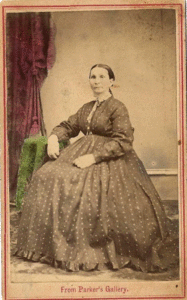 to another picture of her in-laws, who were the slave masters on her plantation. At that point, anyone in the world who took part in the Freedman Project of 2016 could have claimed that it was they who had indexed the pictures and corroborating documents, and I would have been fine with that! I was finally able to establish the link between my new friend Hazel Bauman and her ancestor Annie Wheeler.